Image


The Prakash Lab seeks to understand how lipids regulate glial cell function in the healthy and diseased brain. Glial cells, including astrocytes, microglia, and oligodendrocytes, perform essential functions that regulate immune responses, generate and maintain myelin, support neuronal health, and preserve tissue homeostasis. Lipids are central to these processes, serving as structural components of cellular membranes, metabolic substrates, and signaling molecules that mediate communication between cells.
Despite their importance, we still understand remarkably little about how lipid metabolism is coordinated across different glial cell types or how disruptions in lipid pathways contribute to neurological disease. Alterations in lipid synthesis, trafficking, storage, and degradation profoundly reshape glial function and contribute to neurodegeneration. However, the mechanisms linking lipid dyshomeostasis to neuronal dysfunction remain poorly understood.
Recent work from our lab and others has highlighted diverse roles for lipids across the three major glial cell types. In microglia, lipid droplet accumulation impairs phagocytosis and contributes to Alzheimer's disease pathology (Immunity, 2025; PMID: 40393454). Reactive astrocytes secrete toxic lipids that drive neuronal death (Nature, 2021; PMID: 34616039). In oligodendrocytes, disruption of lipid homeostasis impairs myelin formation and maintenance, contributing to neurodegeneration in X-linked Dystonia Parkinsonism (bioRxiv, 2026; PMID: 41278988).
Together, these discoveries motivate our efforts to uncover the molecular mechanisms by which lipids shape glial function in health and disease and reveal new mechanisms underlying neurodegeneration.
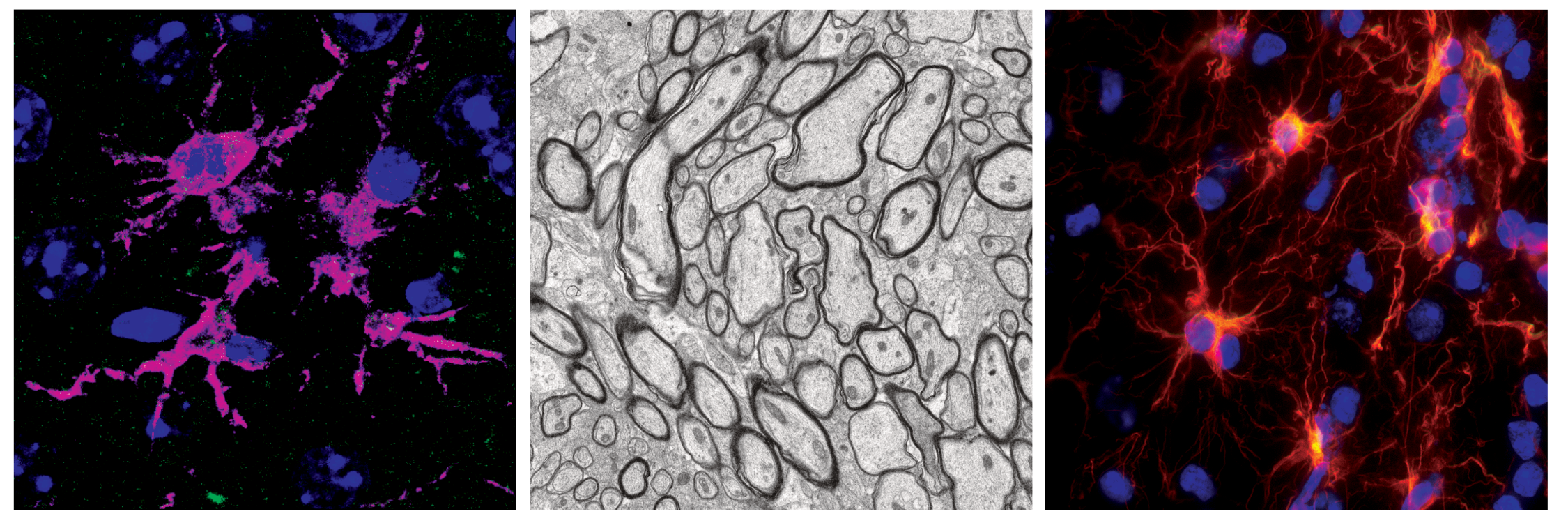
Figure. Representative images of (left) microglia (IBA1, magenta), (middle) myelin ultrastructure visualized by electron microscopy, and (right) astrocytes (GFAP, red) in a wild-type mouse brain.
Cell and molecular biology: We use primary glial cultures and molecular and genetic approaches to uncover mechanisms that regulate glial identity, metabolism, function, and intercellular communication.
Lipid biochemistry: We combine lipidomics, spatial lipidomics, and biochemical approaches to determine how lipids are synthesized, stored, processed, and remodeled across different cells and regions of the brain.
Mouse models: We use genetically engineered and disease-relevant mouse models to determine how glial lipid pathways influence brain homeostasis and neurodegeneration in vivo.
Human studies: We integrate postmortem human tissue and multi-omics datasets to determine the relevance of mechanisms identified in experimental models to human neurodegenerative disease.
We are committed to fostering a collaborative and supportive environment where trainees grow into confident, independent scientists. We encourage everyone, regardless of background or career stage, to ask questions and explore new ideas. Above all, we strive to create a lab where people enjoy coming to work, feel valued, and have fun doing science together.
| 2021–2027 | Postdoctoral Fellowship, Neuroscience Institute for Translational Neuroscience, NYU Grossman School of Medicine New York, NY Advisor: Shane A. Liddelow |
| 2015–2021 | PhD, Chemistry Purdue University, West Lafayette, IN Advisor: Gaurav Chopra |
| 2013–2015 | MS, Biology Purdue University, Hammond, IN |
| 2009–2013 | BE, Biotechnology PES University, Bengaluru, India |
| 2025–2028 | Alzheimer's Association International Research Grant, Alzheimer's Association |
| 2022–2024 | Leon Levy Fellowship in Neuroscience, Leon Levy Foundation |
| 2020–2021 | Eli Lilly–Stark Neurosciences Predoctoral Research Fellowship in Neurodegeneration, Indiana Clinical and Translational Sciences Institute |
| 2021 | PULSe Outstanding Graduate Student in Research Award, Purdue University |
| 2021 | Melvin Guy Mellon Award in Analytical Chemistry, Purdue University |
| 2021 | Linda and Jack Gill Graduate Student Award (Honorable Mention), Indiana University Bloomington |
| 2019 | Outstanding Graduate Student Mentor Award, Purdue University |
| 2018 | Young Investigator Award, Alzheimer's Drug Discovery Foundation |
For a full list of publications, see Google Scholar.
Select publications (*equal contribution; † co-corresponding author).
Priya Prakash, PhD
Assistant Professor
Department of Pharmacological Sciences
Renaissance School of Medicine
Basic Sciences Tower 7
Stony Brook University
Office phone: [to be updated]
Email: p.prakash@stonybrook.edu
Website: https://www.prakash-lab.org/